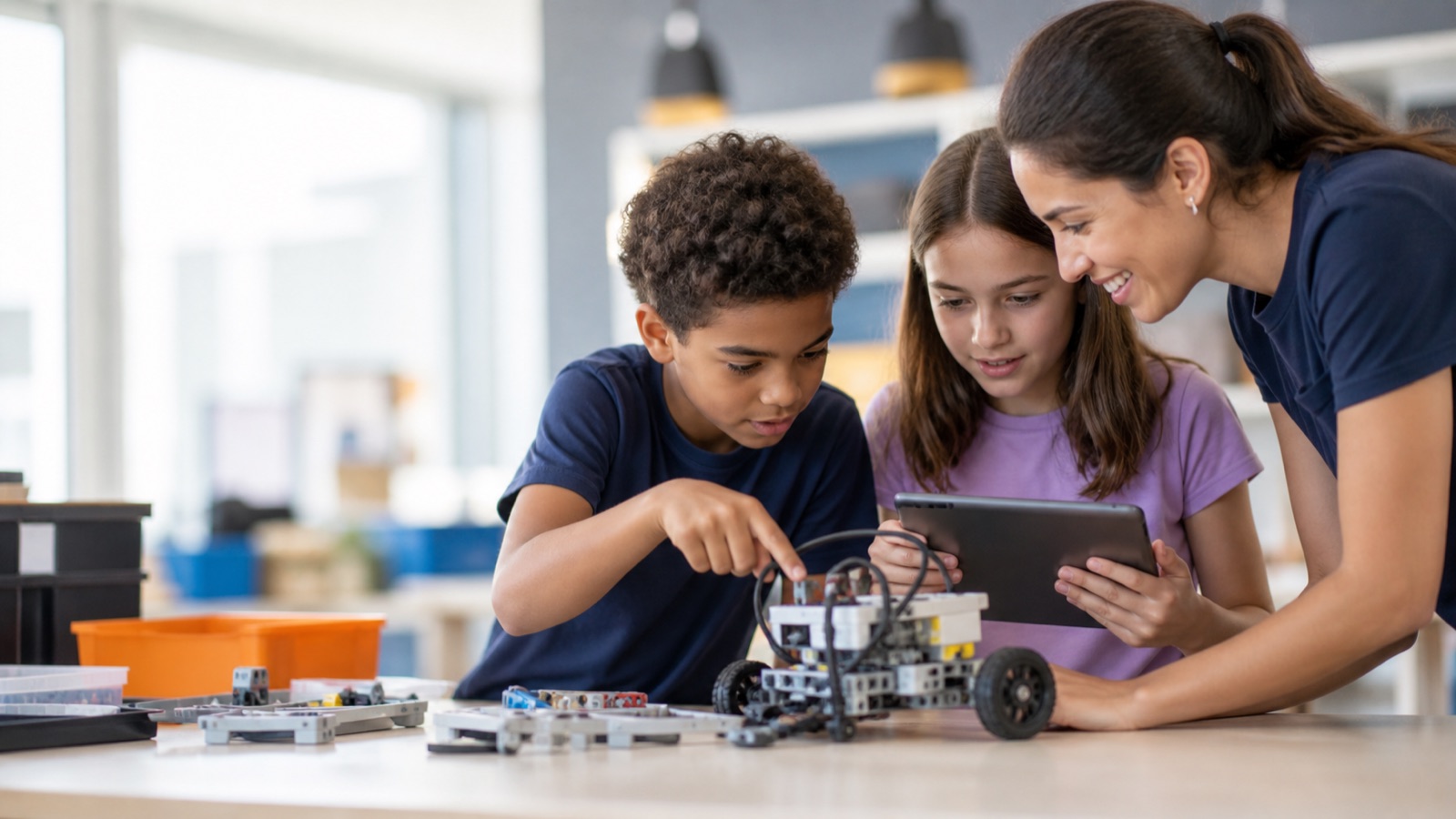
Every maker has met the moment: the model will not balance, the motor does not turn, the code looks right but nothing happens. A well-run robotics experience does not remove these moments. It gives children a safe, supported way to move through them. That is where resilience becomes practical rather than abstract.
Make “not yet” part of the room
Words matter. “That did not work yet” keeps the door open, while “That is wrong” can close it quickly. When adults use language of testing and debugging, children learn that an unexpected result is information they can use.
This does not mean pretending frustration is fun. It means acknowledging it, taking a breath and deciding on one small next step together.
Shrink the problem
A stuck robot can feel like a giant failure. Breaking the challenge into tiny checks makes it manageable: Is the battery connected? Does the motor turn on its own? Is the sequence in the intended order? Each answered question gives the learner evidence that they can make progress.
Teachers can model this aloud. “I do not know why it stopped, so I will check one thing at a time.” Children hear a calm strategy they can borrow.
Let teams use one another
Resilience is not the same as doing everything alone. In a thoughtful group, children ask for a second pair of eyes, explain their plan and build on a teammate’s suggestion. They learn that asking for help is a strategy, not a surrender.
Rotate roles so that different children get to lead the test, record an observation or present the change. Shared ownership prevents one confident learner from carrying the whole challenge.
Celebrate evidence of growth
Rather than praising only a polished final product, name the process: “You noticed the pattern”, “You changed your plan after testing”, “You kept going when the first version failed.” Specific feedback helps children recognise what persistence actually looks like.
A simple before-and-after photo is powerful. It turns a discarded first attempt into proof that revision happened.
Bring the habit beyond robotics
The same approach works with a difficult homework question, a sports skill or a creative project. Pause, name the problem, try one small change and seek another perspective if needed. Robotics gives the habit a memorable physical form.
For young learners, a short phrase can help: “We are not stuck. We are gathering clues.”