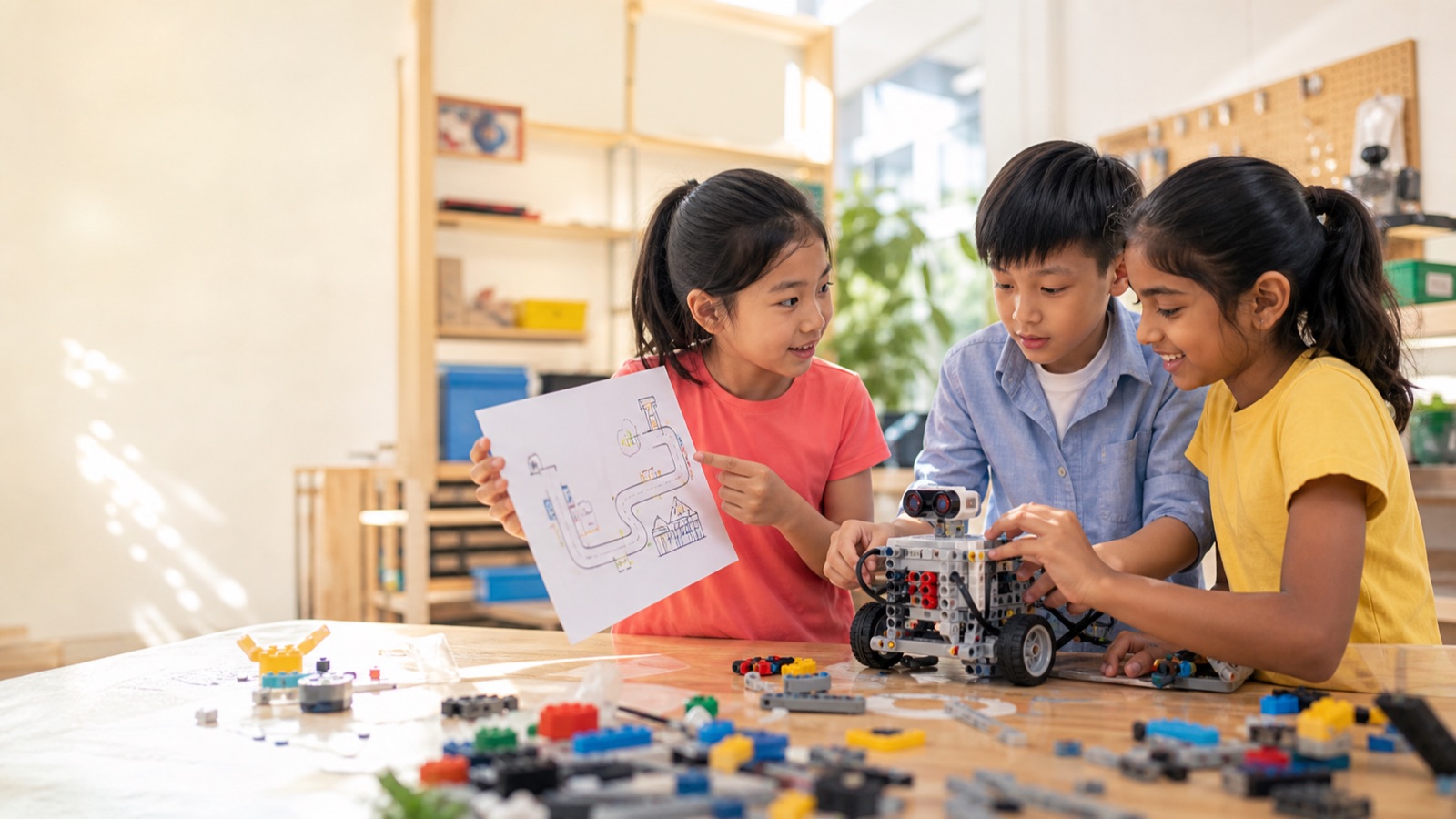
Lateral thinking is the quiet superpower behind questions like “What else could we try?” It is not about getting to the right answer fastest. It is about noticing possibilities, making unusual connections and being willing to take a different route. STEM activities are especially good practice grounds because a model, a mechanism or a piece of code gives ideas somewhere tangible to go.
One challenge, many routes
In a worksheet, a question often points towards one expected response. In a build challenge, the route is more open. A robot may need to cross a line, carry an object or tell a story. One group changes the wheels; another simplifies the route; a third turns the problem around and redesigns the load. Each option is a real piece of thinking, not a detour from it.
This matters because children begin to see that a first idea is a starting point, not a verdict. The aim is not to praise the most complicated answer. It is to make room for observations, alternatives and the question that often unlocks progress: “What if we…?”
Mistakes become useful information
When a model tips over or a sequence does not run as expected, the result is immediate and visible. That can feel disappointing for a moment. With kind facilitation, however, it becomes a clue: which part behaved differently from what we predicted, and what could that tell us?
Children learn to separate the idea from their identity. The build did not work yet; the child is not “bad at robotics”. That small shift builds confidence to test a second and third possibility—exactly the habit lateral thinking needs.
Hands help thoughts move
Young learners do not always begin with a fully formed explanation. Sometimes they need to sort pieces, sketch a path or act out a movement before they can describe their plan. A hands-on task lets thinking happen through fingers, conversation and trial at the same time.
For teachers and parents, this is a useful reminder: ask a child to show their idea before asking them to defend it. “Can you build a quick version?” is often more inviting than “What is your answer?”
Different perspectives improve the design
In a collaborative challenge, one learner may notice a pattern, another may care about the story and another may be determined to make the mechanism reliable. The strongest solutions often arrive when these viewpoints meet. Children practise listening for an idea they did not have themselves and adding to it rather than competing with it.
That is why a thoughtful STEM session includes sharing time. A short “show and tell” makes room for teams to compare routes, borrow inspiration and celebrate clever differences.
Try this at home or in class
Choose an everyday object—a paper cup, a toy car or a small box—and set a playful mission: move it across a table without touching it directly. Start with a few household materials. There is no need to rush to the answer. Encourage three different attempts, take a photo of each version and ask what changed.
The useful question is not “Who won?” It is “Which surprising idea would you like to try next?” That keeps the focus on possibility, persistence and delight.