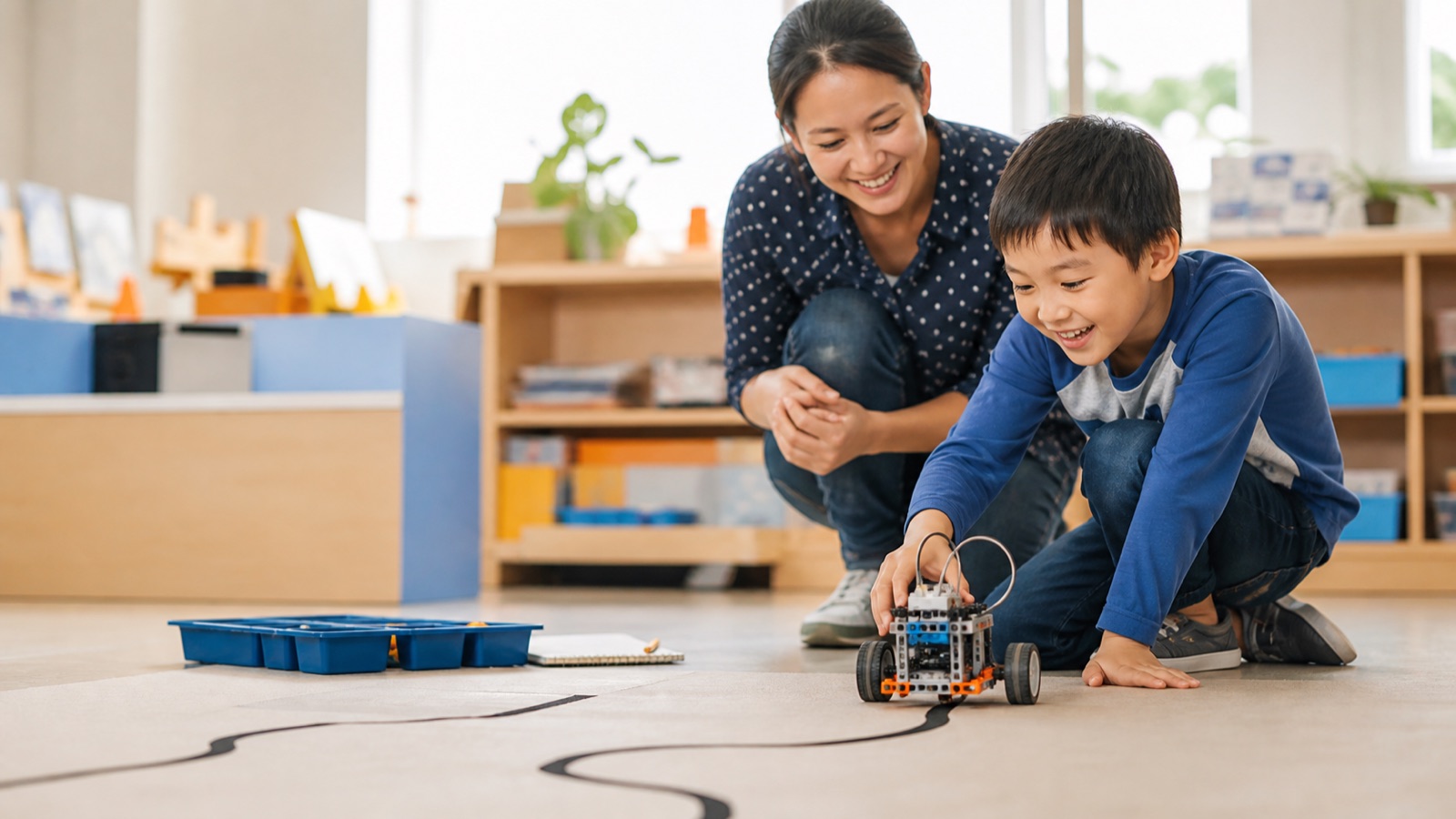
Play can look wonderfully unstructured from the outside: bricks spread across a table, a child trying a funny idea, a group laughing because their robot has gone in circles. Yet purposeful play is rich with learning. It gives children an active role, a safe reason to take a risk and a memorable way to connect an idea with an experience.
Play makes the goal feel like theirs
When a child can make choices about a character, a model or a route, the challenge becomes personal. They are not simply completing an instruction; they are trying to bring an idea to life. That sense of ownership often increases attention and care.
A good prompt is open enough for choice but clear enough to get started. “Build something that can help a tiny animal cross a river” offers a mission without deciding what the bridge must look like.
Curiosity leads to real questions
Play naturally creates questions: Why did that fall? How can it turn? What happens if we make the wheels wider? Those questions are the beginning of scientific and computational thinking. Children notice, predict, test and revise because they want to see what happens next.
Adults do not need to supply every answer. A pause, a raised eyebrow or “What do you notice?” can be more powerful than a quick fix.
It gives language a reason to grow
Building together asks children to explain, negotiate and listen. They use positional language, compare materials and describe a sequence of actions. A learner who is quieter in a whole-class discussion may have plenty to say when pointing to a model they helped create.
Make sharing part of the experience. Invite each team to name one choice they made, one surprise they met and one thing they would change.
It makes effort visible
A finished model is satisfying, but the learning lives in the versions that came before it. A photo of the first attempt or a quick sketch of a changed plan helps children notice their own progress. It says: the work you did to improve this matters.
This is especially helpful for children who expect success to look instant. Play-based learning makes iteration normal—and often fun.
How adults can protect playful learning
Offer time, a clear invitation and materials that can be used in many ways. Resist the urge to make every creation efficient or tidy. Step in for safety, inclusion and encouragement, then leave space for the child’s own next move.
The goal is not to turn every playful moment into a lesson. It is to notice that, with the right environment, play is already a powerful way to learn.